
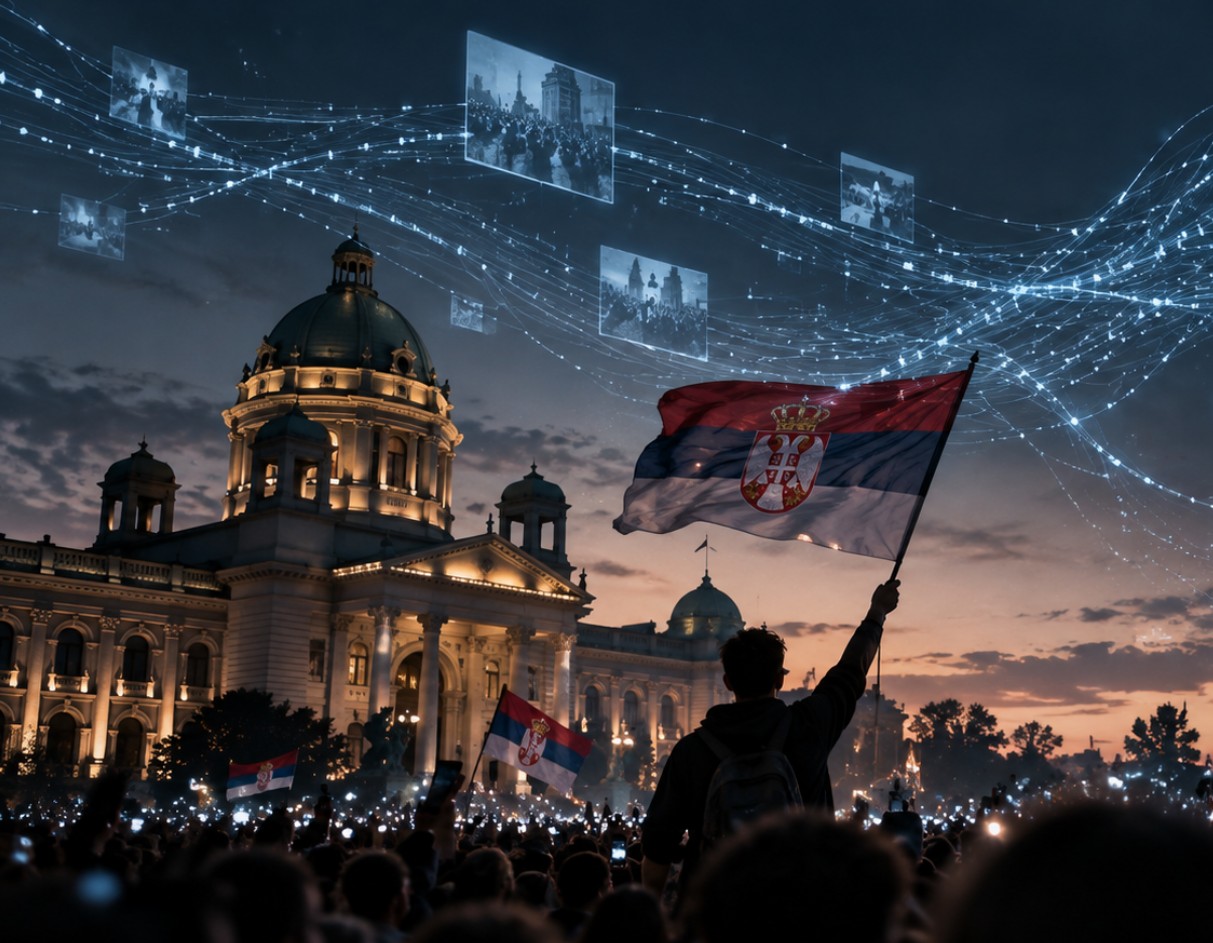
The Impact of the Intelligent Age on Serbia's Elections
How Advanced Technologies Broke the State's Traditional Grip on Public Opinion and Trust
By Stefan Čelić · President of the International Center for Advanced Technologies
Serbia's 2026 parliamentary elections revealed a fundamental transformation in the relationship between technology, society, and political power. The student-led victory was not the beginning of this transformation, but the political consequence of changes that had been developing for years.
Traditional political systems were built around centralized communication, institutional authority, and control over information. The expansion of the Internet, smartphones, social networks, and artificial intelligence has progressively changed these conditions, giving individuals unprecedented access to knowledge, public influence, and collective organization.
The crucial difference in Serbia was not simply between political parties or generations, but between two fundamentally different models of communication and social organization.
The established political system continued to rely heavily on traditional media, institutional structures, and established channels of influence. Meanwhile, an increasingly connected society was developing alternative ways to access information, establish trust, and coordinate collective action.
The student movement demonstrated the potential of decentralized networks, where citizens became active participants rather than passive recipients of political messages. Digital communication accelerated the exchange of information and enabled collective coordination, while direct engagement and local initiatives transformed that connectivity into real-world political participation.
The significance of this transformation extends beyond social media. It represents a gradual redistribution of capabilities that were once concentrated within large institutions.
Artificial intelligence is accelerating this process by making advanced analytical tools, knowledge, and information processing increasingly accessible to individuals and smaller organizations. At the same time, these technologies introduce new challenges involving misinformation, manipulation, and public trust.
Technology alone does not determine political outcomes. However, it fundamentally changes the environment in which political influence operates, reducing dependence on traditional intermediaries and creating new possibilities for decentralized organization.
In the Intelligent Age, political influence increasingly depends not only on controlling communication channels, but on the ability to generate trust, mobilize participation, and coordinate society.
Serbia's experience illustrates a broader challenge facing institutions worldwide: adapting to societies whose technological capabilities, communication patterns, and organizational structures are evolving faster than the systems designed to govern them.
The election did not create a new balance of power. It revealed how far society had already moved beyond the traditional mechanisms of political influence.